

INVOICING & COMMERCIAL CLOSING
Close every transport. Faster.
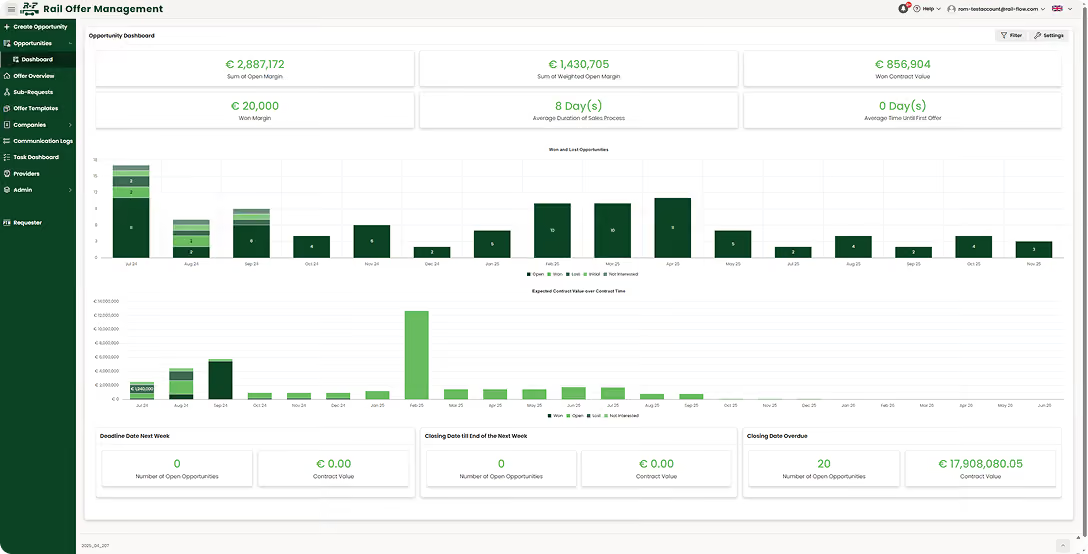
Every transport closes on the actual service performed, not on what was originally booked. Billing lines auto-match against contracts, and execution records, so post-calculation and invoicing run in days instead of weeks. Mode comparisons fall out of the same data, ready to send to customers, auditors, and management.
KEY FEATURES
From executed transport to invoice.
Closing runs on the data the system already has, such as contracts, and execution records. Reconciliation, billing, and reporting from one source. Finance stops chasing operations, operations stop chasing finance.
RECONCILIATION
What you booked, what actually moved.
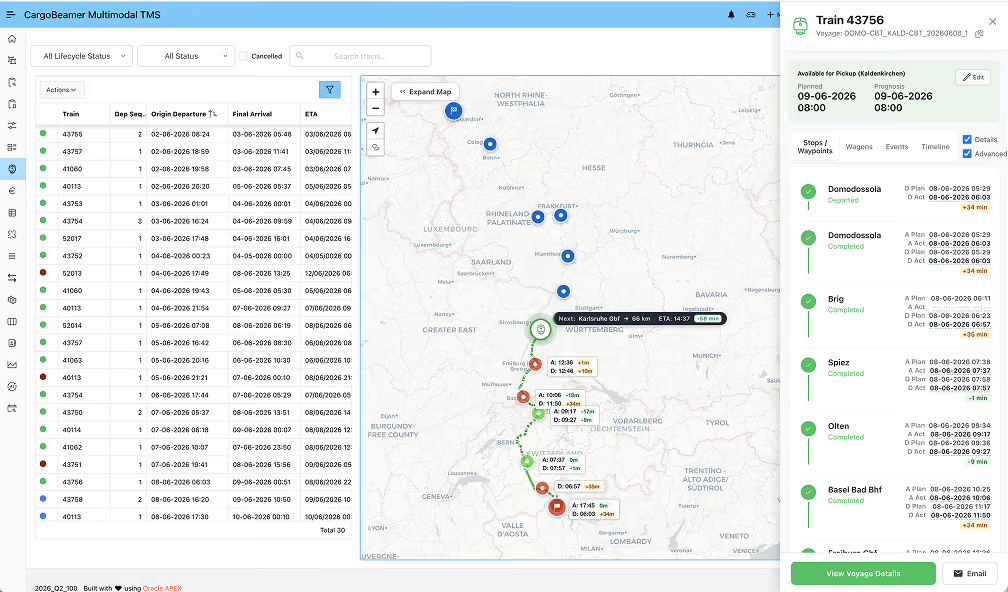
Every transport closes on the actual service performed. Planned vs. executed reconciled automatically against the dispatch record, the track-and-trace events, and the partner’s confirmation, so the closing line reflects the train that actually ran, not the one originally booked.
Differences surface where they happen: wagons added, slots missed, penalties triggered, deviations absorbed. Each one shows up on the closing record with the underlying evidence attached.

Billing
Invoices in days, not weeks.
Billing lines auto-match against contracts, and execution records. Rates, surcharges, fuel indices, and customer-specific terms applied at the line level the moment the transport closes, on every shipment, every leg, every partner.
Customer invoices, supplier invoice verification, and self-billing all run on the same closing record. The system fetches and matches automatically; finance reviews exceptions, then approves and finalizes.
Contract-driven billing logic
Rates, surcharges, fuel indices, and customer-specific terms applied automatically per contract no spreadsheets.
Supplier invoice verification
Incoming partner invoices matched line-by-line to the closing record. Disputes flagged with the underlying evidence already attached.
E-invoicing & ERP handover
TMS delivers output to SAP, Microsoft Dynamics, Oracle, or PEPPOL via an integration configured to each customer's setup rather than a fixed connector, keeping your ERP as the definitive system of record while it handles the reconciled numbers upstream.
REPORTING
KPIs from one record, with CO₂ via integrated emissions data.
Operational KPIs fall straight out of the closing record: punctuality, utilisation, cost, and margin, with no separate BI project and no late-night spreadsheet to reconcile what actually ran. For emissions, route and execution data feeds an integrated calculation service, so CO₂ per shipment and rail-vs-road comparisons come from the same underlying records rather than a parallel sustainability exercise.
One data foundation for the customer report, the auditor file, and the management deck.

SEE IT LIVE
Bring one closing month. We’ll run it through.
A 30-minute walkthrough on your actual reconciliation pain - surcharges, deviations, supplier invoices, or CO₂ reports - with a Rail-Flow rail freight specialist.
Common questions about Invoicing & Commercial Closing.
Five questions every head of finance and head of operations asks before turning automated closing on.
Haben Sie eine Frage, die hier nicht beantwortet wird? Melden Sie sich bei uns, wir antworten innerhalb eines Werktages.

Ganzzüge, Einzelwagenverkehr, intermodale Verkehre und kombinierte Schiene-Straße-Sendungen, sofern Buchung und Ausführungsdatensatz im TMS liegen. Sendungen über mehrere Streckenabschnitte, mehrere Partner und mehrere Verkehrsträger werden alle auf demselben Datensatz abgeschlossen. Für einmalige Transporte außerhalb des Vertragsbestands bleibt der manuelle Abschluss verfügbar.
Preise je Relation, Equipment, Kunde und Zeitfenster. Zuschläge nach Index (Kraftstoff, Energie, Währung), nach Ereignis (zusätzliche Wagen, verpasste Slots, Gefahrgut-Handling) und nach Vertragsklausel. Kundenspezifische Konditionen und Slot-Vereinbarungen greifen automatisch.
Der CO₂-Wert je Sendung wird aus realen Ausführungsdaten berechnet: Traktionsart, Entfernung, Nutzlast und Route. Der Vergleich zwischen Schiene und Straße basiert auf denselben Daten. Die Methodik-Zertifizierung (GLEC, EN 16258) ist Teil der Roadmap; der Wert ist heute je Sendung prüfbar und eignet sich für Kundenberichte und Argumente zur Verlagerung von der Straße auf die Schiene.
Der Abschluss pausiert bei diesem Datensatz und das fehlende Feld wird markiert: ein fehlendes GPS-Ereignis, eine unbestätigte Übergabe, eine Partnerrechnung ohne Nachweis. Der Vorgang erreicht die Buchhaltung mit exakt benannter Lücke. Sobald die Daten eintreffen oder manuell erfasst werden, kehrt der Datensatz in den Ablauf zurück. Nichts wird bei unvollständigen Daten unbemerkt abgeschlossen.
Invoicing & Commercial Closing ist die letzte Stufe des TMS. Die Abschlussdatensätze beziehen ihre Daten aus dem Planboard, aus Track & Trace und aus dem Vertragsbestand und liefern die Ausgabe an SAP, Microsoft Dynamics, Oracle oder PEPPOL, und zwar über eine Integration, die auf das Setup des jeweiligen Kunden zugeschnitten ist statt über einen festen Konnektor. Ihr ERP bleibt das führende System.
MORE FROM TRANSPORT MANAGEMENT
Explore related features.
Discover the other capabilities of the Transport Management solution that feed Invoicing & Commercial Closing with the data it needs.
Real-Time Track & Trace
Live ETAs, proactive exception alerts, and full transport visibility from departure to delivery. Every execution event feeds the closing record.
Automated Order Processing
Turn every booking — EDI, portal, email, or Excel — into a validated, dispatched shipment without manual touch. The data that closing runs on starts here.
Contract Management
Customer and supplier contracts, slot agreements, and pricing structures in one place — the rate basis every closing line reconciles against.