

YARD PLACEMENT & MOVE JOBS
Every unit in the right slot. Every move a job.
Place units by rule and turn every reposition, load, and unload into a dispatched move job, sent straight to your reach-stacker and crane operators, with a live yard the back office can see.
CAPABILITIES
Win productivity on the ground.
Check trucks in and out on one platform: validated steps, mandatory photos and signatures, and a live gate the back office can see in real time.
Placement
Rule-based placement, not guesswork.
Every unit gets a storage location by rule at gate-in — by unit type, customer, dangerous goods, FIFO for empties, or siding — automatically, or assigned by a planner. Like stays with like, and fast-movers stay reachable.
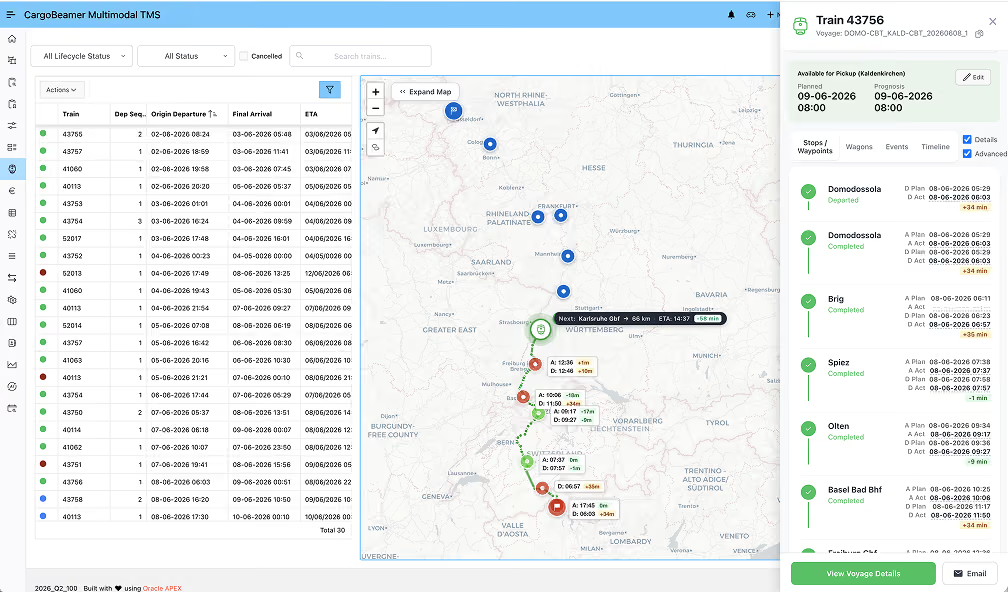
Live parking utilisation shows total spaces, occupied slots, and utilisation rate, so planners see capacity before they commit the next unit — and the next move stays short.

Move jobs
Every move a dispatched job.
Every reposition, load, and unload becomes a move job — origin, destination, equipment, and priority — that lands on the reach-stacker and crane operators’ mobile screens in real time, not over the radio. Shunter workflows cover loading with plan checks, unloading with position documentation, train composition, and replenishment, and units are auto-allocated to wagons so the plan and the yard stay in step.
Move-job dispatch to equipment
Jobs sent to reach-stacker and crane operators with priority, in real time.
Shunter mobile workflows
Loading, unloading, train composition, and replenishment on role-based screens.
Unit-to-wagon auto-allocation
Units allocated to wagons from the plan, so composition is right first time.
Yard visibility
See the whole yard, block the wrong move.
The whole yard is visible in real time — parking utilisation, company-filtered unit overviews, and Wagon Loader status tabs (Gate-In, Plan, Backup, Loaded) aligned with the back office.
Before any load, back-office plan-checks validate capacity, dangerous goods and out-of-gauge, allowed units, and holds — and hard-block on errors, so mistakes are caught on screen, not on the track.

YARD PLACEMENT & MOVE JOBS
See it in action. Book a demo.
Get a personalised walkthrough of how placement and move jobs work for your yard.
Frequently asked questions.
Everything you need to know about yard placement and move jobs. Anything missing? Just ask during your demo.
Haben Sie eine Frage, die hier nicht beantwortet wird? Melden Sie sich bei uns, wir antworten innerhalb eines Werktages.
Regelbasiert beim Gate-in, anhand von Einheitentyp, Kunde, Gefahrgut, FIFO für Leereinheiten und Anschlussgleisen, automatisch oder durch einen Planer. Die Live-Auslastung der Stellflächen zeigt die Kapazität an, bevor die Einheit fest eingeplant wird.
Eine disponierte Anweisung für eine physische Bewegung: Ausgangsort, Ziel, Equipment und Priorität. Umsetzungen, Beladungen und Entladungen werden alle zu Move Jobs, die in Echtzeit auf dem Mobilgerät des Bedieners erscheinen und Funksprüche ersetzen.
Beladen mit Planprüfungen, Entladen mit Positionsdokumentation, Zugbildung und Nachschub, auf rollenbasierten Oberflächen, die sich in Echtzeit mit dem Back Office synchronisieren.
Planprüfungen im Back Office validieren vor jeder Beladung die Kapazität, Gefahrgut und Lichtraumüberschreitungen, zulässige Einheiten und Sperren und blockieren bei Fehlern hart. Einheiten werden den Wagen automatisch zugeordnet, damit die Zugbildung korrekt bleibt.
Die Stellplatzzuweisung ergibt sich aus dem Lkw-Check-in, Bewegungsdaten aktualisieren das Portal und den Status im Wagon Loader, und dieselben Einheiten fließen in das Be- und Entladen der Züge und in die Abrechnung ein.
MORE FROM TERMINAL OPERATIONS
Explore related features.
Discover other capabilities of the Terminal Operating System that work alongside yard placement and move jobs.
Truck Check-In & Check-Out
The gate feeds the yard — every unit that checks in gets placed by rule and enters the move queue automatically.
Train Loading & Unloading
Plan-checked loading and unloading with wagon position and timestamps, from the same units that entered at the gate.
Damage Reports & Sign-on-Glass
Capture damage with photos at the barrier and require a mandatory digital signature on every gate move, with a full audit trail.