Der Schienengüterverkehr hat ein Dispositionsproblem. Die Hotellerie hat es längst gelöst.
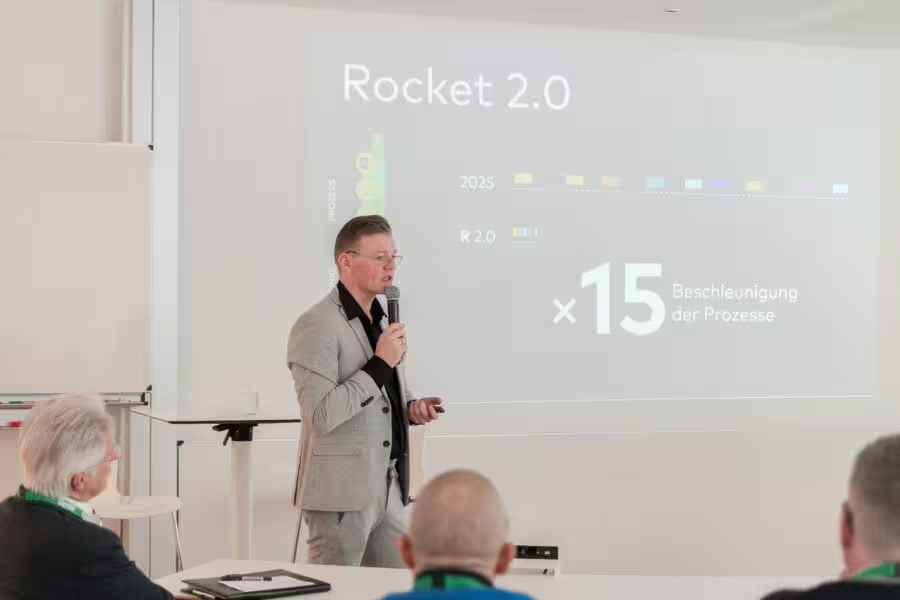
MICE-DESK-CEO Bernd Fritzges argumentiert auf der railXchange 2026, dass die orchestrierte, menschlich kontrollierte Automatisierung, die den Vertrieb von Hotel-Tagungen vor einem Jahrzehnt transformiert hat, direkt auf das Dispositionschaos im Schienengüterverkehr übertragbar sei, und fragt, warum die Branche noch immer zögert, sie zu übernehmen.
Irgendwo in einem Schienengüterverkehrsbetrieb arbeitet gerade jetzt ein Disponent über drei Bildschirme hinweg, kopiert Daten aus einem System ins nächste, jagt einer telefonischen Bestätigung hinterher, bevor er ein drittes System aktualisieren kann. Der Prozess, den er steuert, dauert Stunden. Er produziert Fehler. Er funktioniert seit Jahren so – weil er schon immer so funktioniert hat – und niemand hatte bisher die Zeit oder das Mandat, ihn grundlegend zu ändern.
Bernd Fritzges kennt diesen Moment genau. Nicht aus der Bahn, sondern aus einer Welt, die vor zehn Jahren fast identisch aussah, aber heute besser dasteht.
Fritzges ist CEO von MICE DESK, einer Plattform, die den Tagungs- und Veranstaltungsverkauf in der Hotellerie digitalisiert und automatisiert hat. Die Hotellerie ist ein Markt, der durch genau jene Eigenschaften geprägt ist, die auch den Schienengüterverkehr schwierig machen: komplexe, multilaterale Koordination; Echtzeit-Verfügbarkeitsbeschränkungen; hohe Einsätze pro Buchung; und ein Erbe analoger Arbeitsabläufe, von denen alle wussten, dass sie ineffizient sind – ohne dass je jemand eine skalierbare Lösung daraus gemacht hätte.
In der Optimierungs-Session der railXchange 2026 war seine Botschaft an die Bahnbranche präzise und bewusst unbequem: Die Technologie, die in der Hotellerie aus einem Stundenprozess einen Minutenprozess gemacht hat, ist nicht neu. Sie existiert, sie funktioniert – die Frage ist, warum die Bahn noch wartet.
What “orchestrated” actually means
Fritzges titled his session How Orchestrated Systems Turn Chaos into Control, and the word orchestrated is doing important work in that phrase.
The typical approach to automation in complex industries is to identify a single painful process, digitise it, and declare progress. The scheduler gets a better tool. The pricing team gets a better tool. The customer service team gets a better tool. Each improvement is real. But because each tool operates in isolation, the coordinator between them, usually a human, usually under pressure, is still manually moving information from one system to the next. The chaos hasn’t been removed. It has just been relocated to the handoffs.
Orchestration is a different design philosophy. Instead of optimising individual steps, it rethinks the connective tissue between them: the triggers, the data flows, the decision points, the moments where a human genuinely needs to be in the loop versus the moments where a rule or an algorithm can handle it faster and more reliably. The result is not a faster version of the old process. It is a fundamentally different process that happens to be operated by fewer people with less friction and more control.
In hospitality, this meant connecting availability, pricing, proposal generation, contract issuance, and confirmation into a single orchestrated flow: one where a request that previously required hours of back-and-forth between a sales manager, a revenue manager, and a contracts team could be resolved in minutes, with humans reviewing outcomes rather than executing steps.
In rail freight, the equivalent opportunity is vast. Scheduling, capacity allocation, disruption management, customer communication, billing – the steps are different, the data is different, the regulatory context is more complex. But the structural problem is identical: fragmented systems, manual handoffs, coordination overhead that grows non-linearly as the network expands.
The measurement that changes the conversation
One of the most clarifying things Bernd brought to the session was a specific claim: the transformation he described at MICE DESK produced a measurable commercial uplift. Not just efficiency gains. Not just cost reduction. Revenue that would not have existed without it, because the speed of response and the quality of the offer had become a competitive differentiator.
This reframe matters enormously for how the rail industry tends to approach automation decisions. The default justification for process improvement is cost reduction – lower headcount, lower error rates, reduced manual work. These are real benefits, but they are slow to materialise, politically sensitive, and rarely sufficient to secure the investment and organisational will that genuine transformation requires.
The hospitality experience suggests a different calculation. When you can respond to a request in minutes instead of hours, you win business that previously went elsewhere simply because a competitor was faster. When your proposals are consistent, accurate, and generated without manual effort, your conversion rate improves. The automation doesn’t just reduce cost, it expands the addressable market by making the operation capable of handling volume and complexity that was previously out of reach.
Rail freight operators managing capacity across multiple corridors, dealing with spot requests alongside contracted flows, coordinating last-minute adjustments with multiple infrastructure managers, the analogue is closer than it first appears.
Fully integrated. Fully automated. Human-controlled.
Fritzges was careful about one thing: automation does not mean humans disappear from the process. His framing, fully integrated, fully automated, human-controlled, describes something specific and important.
The human role in an orchestrated system is not eliminated. It is elevated. Instead of spending cognitive energy on data transfer and process coordination, the people who understand the business are spending it on judgement calls, exceptions, relationships, and strategy. The machine handles the predictable. The human handles the complex.
This is a more honest description of what good automation actually looks like in practice than the extremes that tend to dominate the conversation, either “AI will replace everyone” or “nothing will really change.” What actually happens, when it is done well, is that the nature of the work shifts. Less time in the inbox, more time thinking.
For an industry facing skilled labour shortages, where experienced dispatchers and schedulers are retiring and the knowledge embedded in their heads is difficult to transfer, this is not just an efficiency argument. It is a resilience argument. Orchestrated systems capture institutional knowledge in the logic of the workflow. They make the operation less dependent on any individual’s heroics to hold it together.
The question Bernd left in the room
He closed, as he had opened, with the question his LinkedIn post had already flagged for anyone paying attention: Why is the rail industry still waiting?
It is not a rhetorical provocation. The tools exist. The proof of concept exists, in hospitality and in adjacent industries. The structural problems that make rail freight hard are not uniquely hard — they are familiar to anyone who has operated a complex, multi-party, real-time coordination business. The only genuine differentiators are regulatory complexity and the pace of legacy system replacement, neither of which is an argument for inaction.
The organisations that start building orchestrated systems now, connecting their existing tools, identifying the handoffs where humans are doing work that logic could do, creating the foundation that AI can build on, are not taking a risk. They are reducing one.
Bernd Fritzges is CEO of MICE DESK, a platform specialising in AI-driven process automation for convention and event sales in the hospitality industry. He spoke in the Optimisation session at railXchange 2026 in Frankfurt.