Logistics wins wars: key takeaways from Military Schengen 2026 in Hamburg
Why fast, reliable rail logistics is now a strategic priority for Europe’s defence.
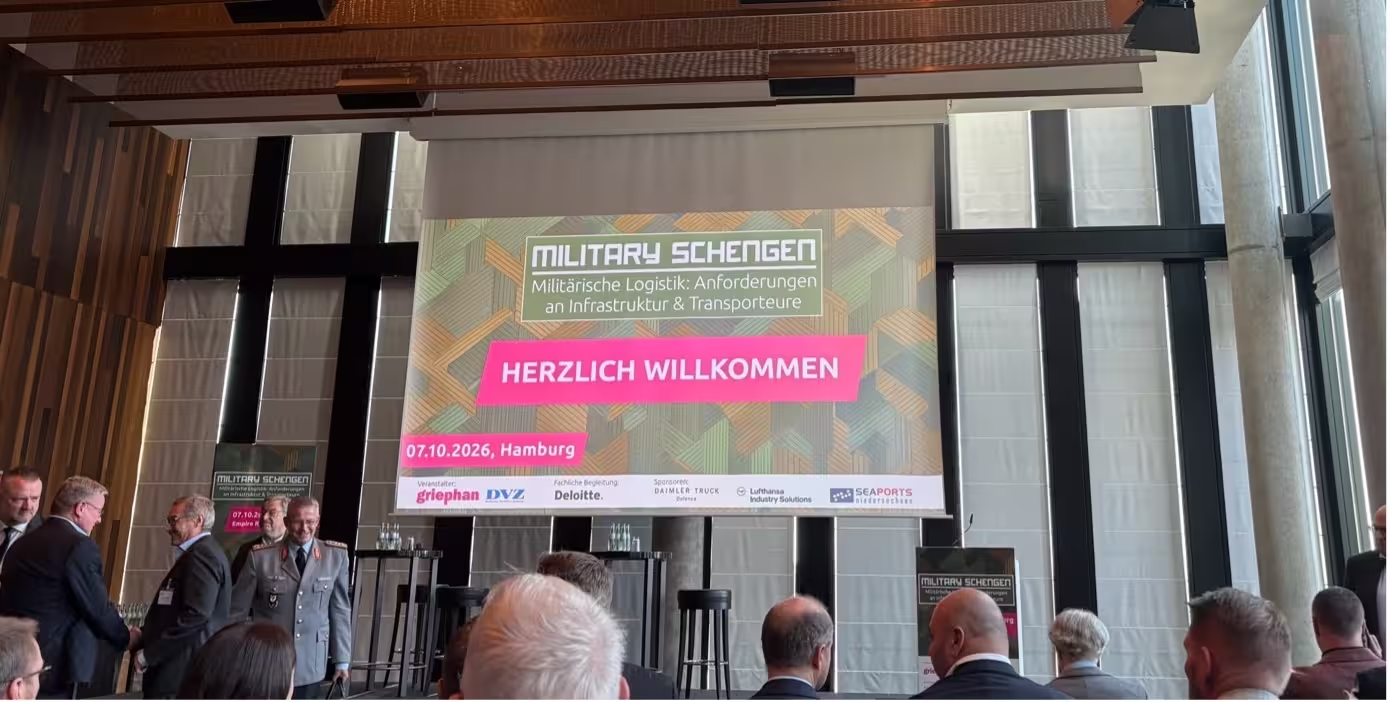
When people think about defence, they usually think of tanks, drones and budgets. At Military Schengen on 7 October at Hamburg’s Empire Riverside Hotel, the focus was on something less visible that determines whether any of it arrives at all: logistics. And with it, rail.
Our colleague Saskia Misselhorn attended the event in Hamburg on behalf of Rail-Flow. For us, the day was particularly insightful. When a crisis calls for more routes, more partners and shorter deadlines, the question of how quickly rail transports can be tendered and awarded becomes a strategic one. This is exactly the challenge that our Purchase & Tender Management (PTM), a module of the Rail-Flow Marketplace, solves.
Europe must move faster and invest more in defence
EU Commissioner Andrius Kubilius opened the conference with seemingly dry figures. Russia plans to increase its military budget for 2027 by a third to around €180 billion. Adjusted for purchasing power, this is roughly equivalent to the combined spending of all EU member states. His conclusion: Russia has not yet been deterred, and Europe must move faster.
Kubilius made it clear that money alone is not enough, quoting General Pershing: “Infantry wins battles, logistics wins wars.” Troops and equipment are of little use if they do not arrive where they are needed, when they are needed. Two figures illustrate the scale of the task. The largest NATO exercise since the Cold War moved 90,000 soldiers over five months. In a crisis, it would have to be 500,000 in 180 days, right across Europe. A deployment on this scale has never happened before.
A Schengen for soldiers and the courage to be more pragmatic
In Europe, freedom of movement applies to citizens, but not to troops. In some countries, a military transport requires up to 45 days’ advance notice. Getting from Spain to the Baltic states can take months.
The European Commission’s package aims to close this gap:
- One set of rules. Common EU requirements instead of 27 national regulations.
- Three days. No authorisation should take longer than that. In an emergency, six hours’ notice is sufficient.
- One document. A single customs document and a shared digital platform.
- Dual use. Around €17 billion in the next EU budget for infrastructure that can be used for both civilian and military purposes.
- Solidarity pool. Member states share lorries, wagons, ships and aircraft.
Germany as a hub
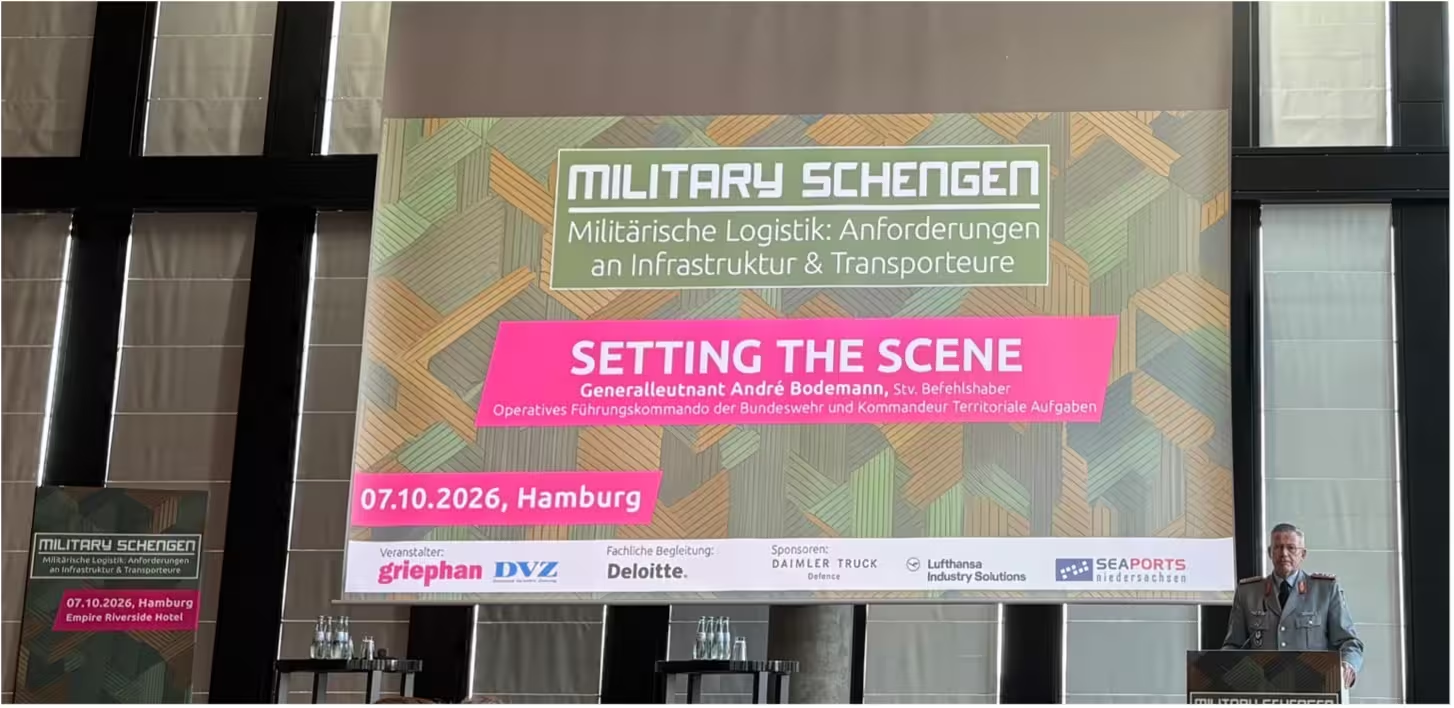
In his speech, Lieutenant General André Bodemann left no doubt about Germany’s role. In a crisis, up to 800,000 soldiers and their heavy equipment would have to move through the country to NATO’s eastern flank. That is significantly more than the 500,000 Kubilius had cited for deployment across Europe, because Germany does not merely let formations pass through; it also receives them and provides troops of its own. Colonel (GS) Anja Buresch-Hamann (Bundeswehr Joint Forces Operations Command) described exactly this triple role: transit country, host nation and troop contributor at the same time, each with entirely different requirements.
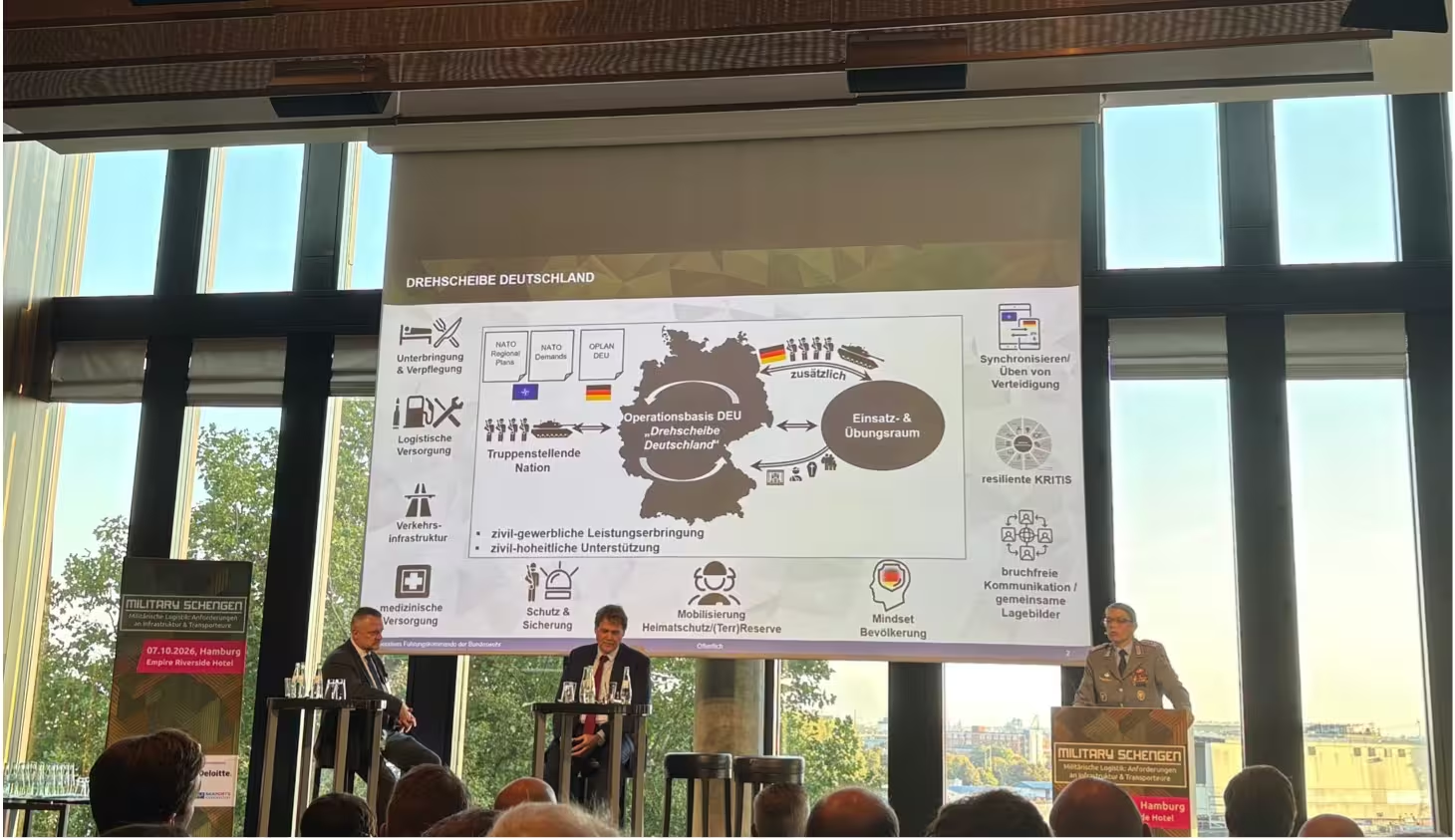
Nevertheless, credit where credit is due: progress in Germany is already visible. The framework agreement for rest and assembly areas is in place, and Bremerhaven and Emden are under discussion as deployment hubs. There are standby contracts with Deutsche Bahn that would have been unthinkable just eighteen months ago. Dr Markus Ksoll (Deutsche Bahn) put the funding for standby capacity in the 2027 draft budget at 380 million euros, 160 million more than in the previous year. At the same time, a core military rail network is being established. As part of this, an assessment was made of where tunnels, platforms and curve radii are insufficient for wide, tall and heavy equipment.
Better three partners than one who drops out when it matters most
Things got particularly candid on the question of reliability. When the Bundeswehr had to supply its troops in Lithuania in the first weeks after the invasion of Ukraine, by no means all civilian service providers played along.
Dr Marc Lemmermann (Rheinmetall Project Solutions) showed how this unpredictability and the associated risk can be factored in from the outset. For every service there are at least three partners, deliberately drawn from small and medium-sized enterprises. If one drops out, the next is ready to step in. This was put to the test in Nienburg, without warning the subcontractors in advance. They had to be in place within two days. Bodemann advised the companies in the room to do the same and to plan reserves from the start.
Logistics is once again a high-value target
One idea ran through the afternoon: the world is turning faster than plans can be written. A few years ago, hardly anyone would have expected robotics, automation and AI to shape the war in Ukraine so profoundly. Ukrainian industry has responded with innovation and rapid scaling. Even the last kilometres of supply there increasingly rely on drones and robots instead of lorries.
This leads to three shifts:
- For the first time in around 30 years, logistics is once again an “absolute high-value target” rather than a side issue.
- Lorry drivers are becoming a “high-value asset” because they are targets for attack drones that can be produced cheaply and quickly.
- Large container and fuel depots and large logistics units are vulnerable. The answer is dispersal, in other words spreading them across many locations.
In concrete terms, this means more routes and more logistical effort for the industry.
The question put to the companies in the room was therefore: how innovative are we in Germany when it comes to logistics, and how quickly could we scale up massively? The answer also depends on binding contracts. Nobody builds a new production line on the strength of options alone. That requires several reliable partners, fallback plans and, above all, speed. Decisions need to be made faster and processes need to run faster, without compromising on quality.
The second line matters too
Procurement is changing as well. Requirements are pooled in Ulm and then put out to tender by the Bundeswehr, the NATO Support and Procurement Agency (NSPA), NATO and other bodies. On the regulatory side, the trend is towards joint procurement, for example through the ongoing revision of the EU public procurement directives and of Directive 2009/81/EC on defence procurement. At the same time, defence remains strongly national in character.
For rail, it is therefore worth taking a close look at the structure. The standby contracts are currently between the Bundeswehr and DB Cargo, and this is not expected to change in the foreseeable future. Railways that are not federally owned come into play as subcontractors via DB Cargo. In a crisis, they form the “second line of defence”.
Whether more routes and more volume can actually be moved is therefore not decided by one contractual partner alone. It also depends on how quickly clients can find, request and commission the right rail freight operators and freight forwarders. Today, this still happens far too often via emails, Excel spreadsheets and phone calls.
This is exactly where PTM comes in
With Rail-Flow’s Purchase & Tender Management (PTM), rail transports are tendered and awarded via a digital platform. The requirements discussed at the Military Schengen conference in Hamburg largely match what PTM already delivers today:
- Speed. If authorisations are to be possible within three days and notifications within six hours, awarding contracts must not become the bottleneck. With PTM, comparable offers are available within a few hours, and contracts can be awarded on the same day.
- Reserves. The principle of “at least three partners per service” requires knowing those partners. The provider directory gives access to more than 350 rail freight operators and freight forwarders from 27 countries, filterable by region, type of transport, dangerous goods capability and certifications.
- More routes. Dispersal means more transports on a smaller scale. Spot requests go out to all relevant providers at short notice, regular tenders cover up to several hundred routes, and complex transports can be tendered in sections.
- Comparability. Standardised offers with a uniform pricing model, services and additional charges make decisions transparent, even under time pressure.
- Confidentiality and traceability. Closed bidder groups, a non-disclosure agreement (NDA) function and sealed bids protect sensitive requests. A complete audit trail provides the documentation for compliance and procurement at the same time.
Reflecting on the experience in Lithuania, Buresch-Hamann summed it up: “Reliability does not show itself in peacetime, but when things get uncomfortable.” To ensure that it does not depend on chance when that moment comes, structures are needed that already work in peacetime.
Closing remarks
Bodemann closed the day with three thoughts.
First: aspiration and reality are far apart, national interests slow things down, and yet we have to work with what we have.
Second: the mindset has to change. Industry and the Bundeswehr need to talk to each other, and reliability is not a one-way street.
Third: things are moving. Since 2023, a great deal has happened at the railways, the ports, the Ministry of Transport and in industry, and it is perfectly fine to say so.
The parties involved have different motives but the same goal: peace in freedom. Kubilius had summed it up at the start: NATO cannot do it alone, nor can the member states, nor can the military or civil society on their own. But together it is possible, and logistics plays a decisive role in this.
How quickly could you tender and award a rail transport today?
Find out more about PTM or book a demo with us directly.