Back from Trimble Insight Europe 2026: Why rail needs better conditions, not just better intentions
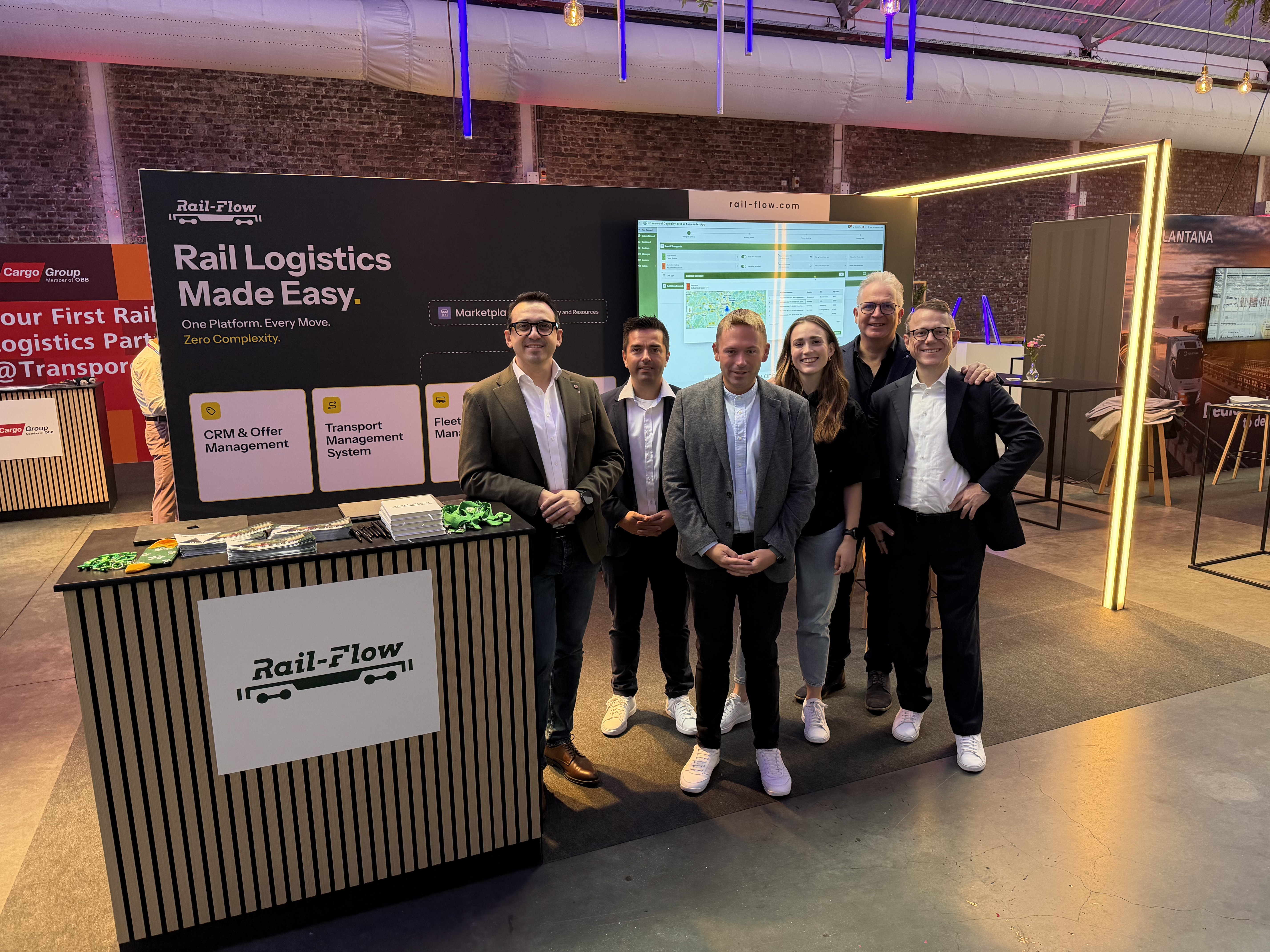
Rail-Flow reflects on Trimble Insight Europe 2026 in Brussels, where talks, presentationsand conversations with participants all pointed in the same direction: roadremains the default for shippers, but rising road costs and the need for end-to-endsolutions make the case for finally making rail as easy to use as road.
As much as AI facilitates logistics and helps us to connect digitally, Trimble Insight Europe 2026 in Brussels was a reminder of why personal exchange still matters in logistics. For two days, six Rail-Flow colleagues brought their energy to the booth and into every conversation.
Road is still the default, and there is a reason for it
One theme came up again and again: road transport remains popular because, for shippers, it is simply easier. Booking a truck is fast, familiar and digital. Booking rail still means more parties involved, more coordination and more manual work. As long as that convenience gap exists, good intentions alone will not move freight to rail.
But the equation is changing. Road transport is becoming more expensive, and that shifts the economics. Shippers who relied on road for its convenience now have a reason to look at alternatives, and rail has to be ready when they do. That means better conditions: processes that are digital, networks that are connected, offers that scale across operators and borders.
Our Co-founders and Co-CEOs Dominik Fürste and Osman Akdemir took that argument on stage twice and in front of the camera once. Three moments stood out.
1. "Nobody chooses road out of conviction": on stage with CargoBeamer
The joint session by Dominik Fürste and Nicolas Albrecht from CargoBeamer opened with an experiment. The audience was asked to stand up, and to stay standing only if someone had ever asked them to shift transport to rail. Almost the whole room stood. Then came the second question: who had actually shifted? Only a handful stayed on their feet.
"We all know that nobody chooses road out of conviction. They choose it because of very practical problems."
Dominik Fürste, Co-CEO Rail-Flow
Those problems are well known: roughly 90 percent of trailers cannot be craned, booking still runs on email, Excel and PDF, and once the train has left, shippers are blind.
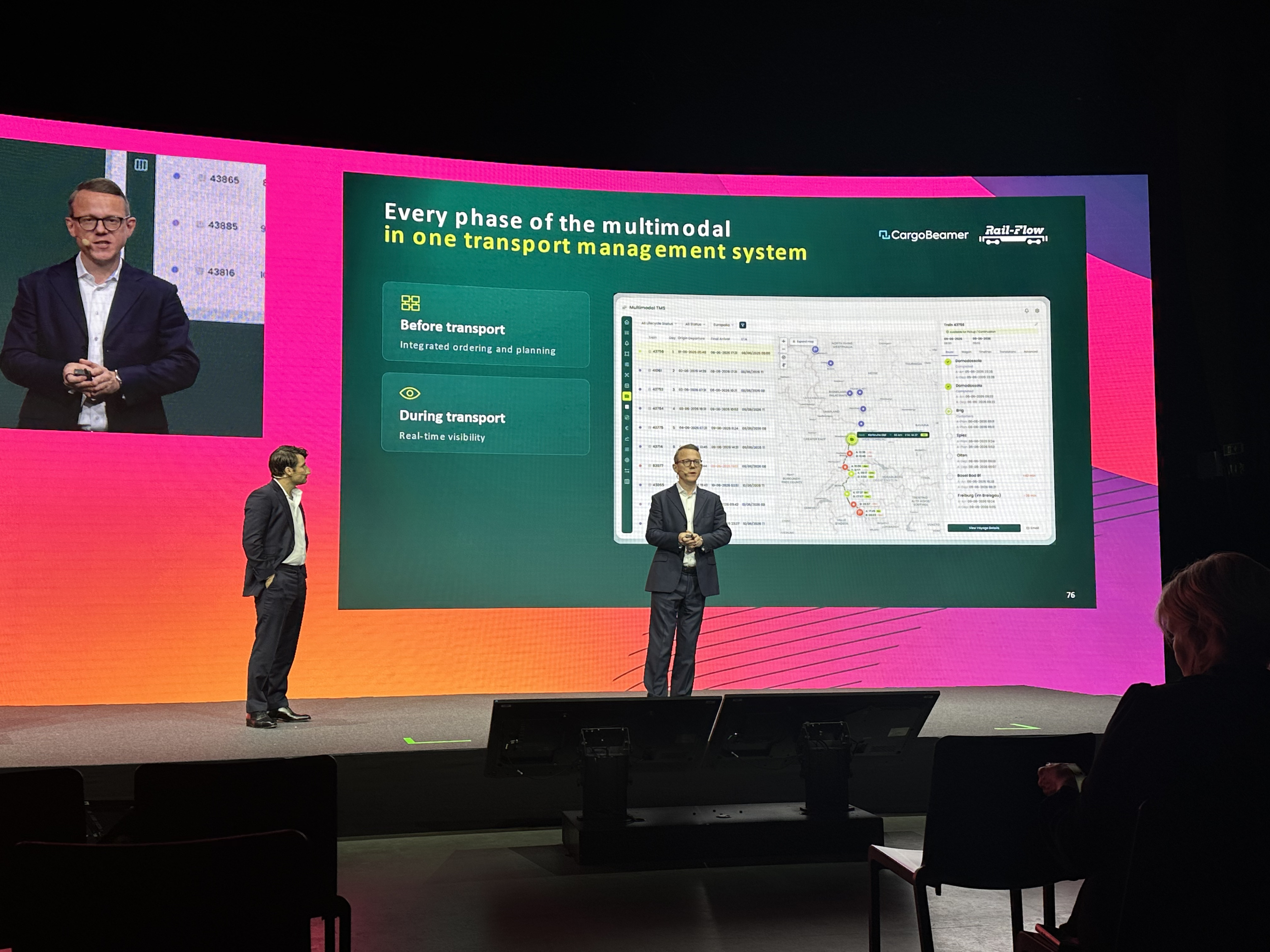
CargoBeamer answers the physical part. Every trailer can go on rail, including mega, reefer, silo and tank units, without reinforcement or special equipment. Frequency has grown from 10 round trips per week in 2020 to 20 today, with more than 33 planned for next year. The goal is a "highway on rail": as fast and flexible as road, but cheaper and far better for the climate. That speed is worth little if the process behind it stays analogue.
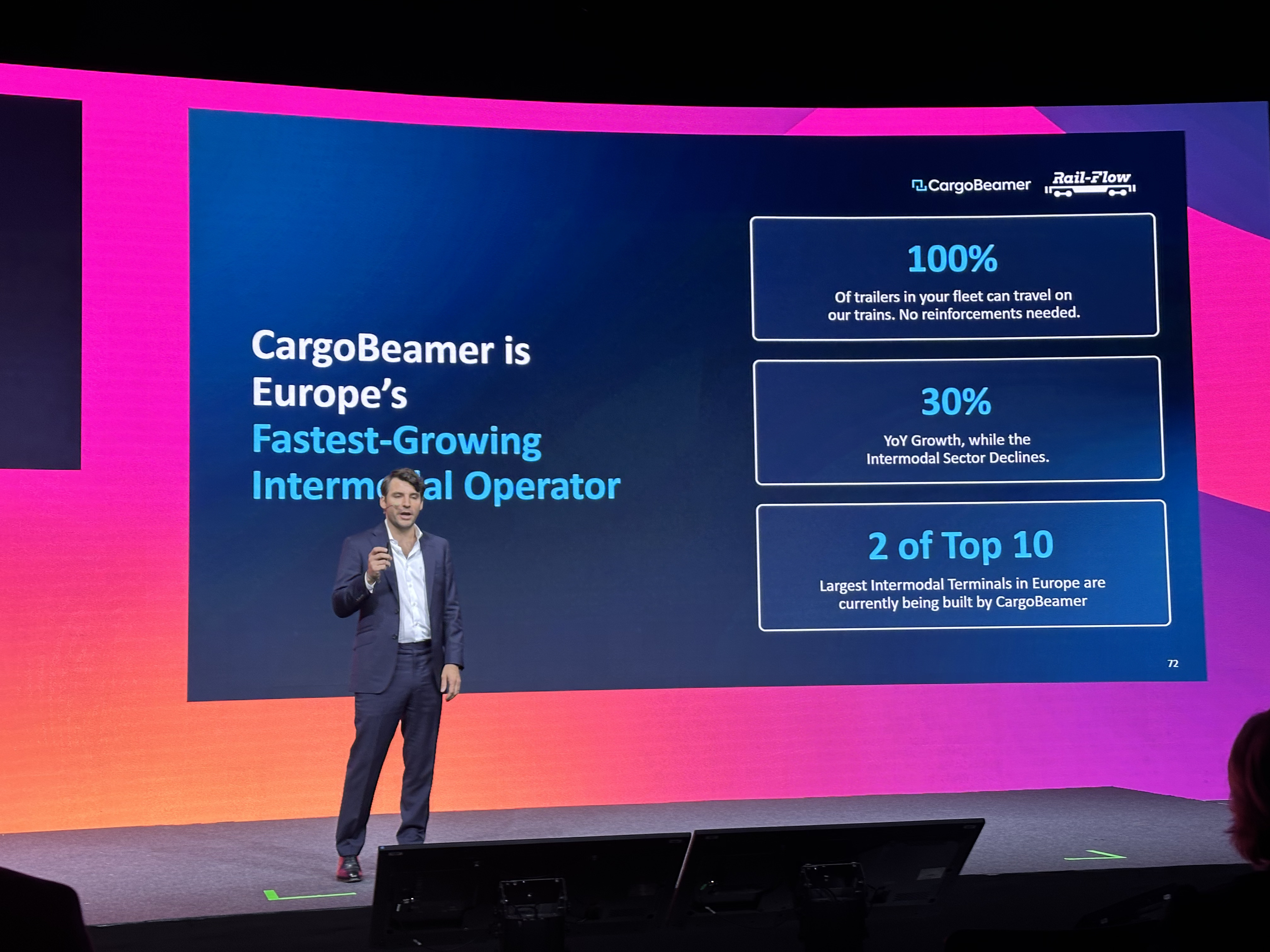
Together, both companies implemented a modern multimodal Transport Management System in six months instead of the usual two years, with slot booking, live tracking and the full order-to-cash process through to automatic invoicing. Book a slot the way you book a truck, see where your unit is with one click, and get the invoice the moment the wheels stop. The point is not to win a single shipment for rail. The point is that whoever shifts stays on rail.
2. "Noise cancellation for rail": the Rail-Flow Insight interview
In the Rail-Flow Insight interview, moderated by Thomas G. Kistner, Osman Akdemir took on the topic that shaped the whole event: agentic AI in logistics. He started with the gap that defines the problem. Book a truck and you can follow it on your smartphone. Book rail and you still have to call someone.
"Rail is loud, above all in managing it. The same data gets entered over and over, the same questions get asked again and again. I see AI agents as noise cancellation for rail."
Osman Akdemir, Co-CEO Rail-Flow
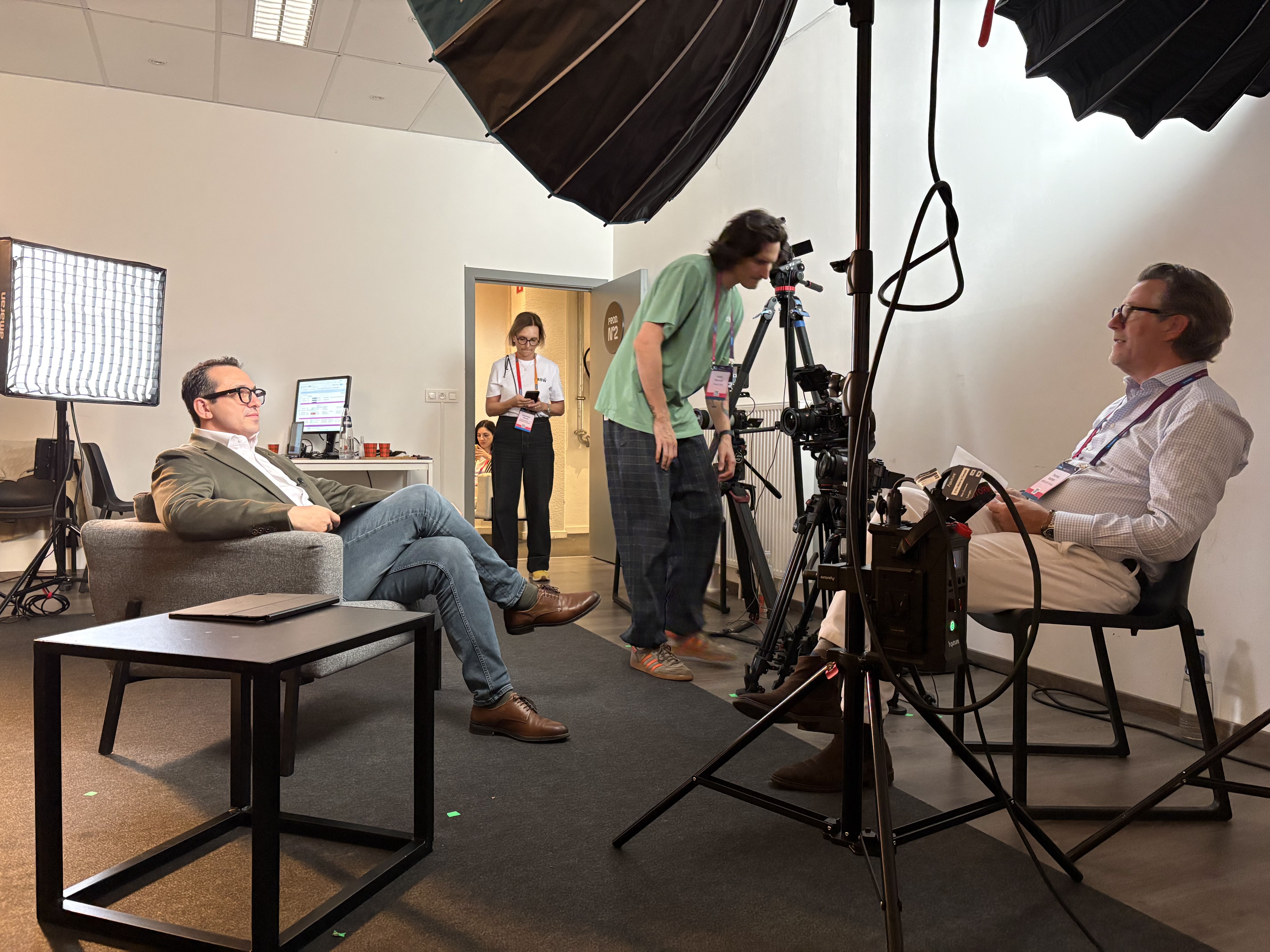
The promise is not a magic end-to-end solution. It is a tidy desk, so that the exceptions that really need a human get the attention they deserve. The biggest lever sits in the handovers: in intermodal rail, one booking changes hands five or six times, and each time the same data is entered again and some of it gets lost.
Why support an event like Trimble Insight Europe as Platinum Partner? Because this is where the people sit who can actually decide on a modal shift. At rail-only conferences everyone agrees with you. That feels good, but it does not move a single container.
3. Beyond the pledge: turning commitments into shipments
On the second day, we joined the panel "Beyond the Pledge: Making Sustainable Logistics Actually Work" with Christoph Lewisch (Rail Cargo Group), Fernando Liesa (ALICE) and Tim Ludwicki (Amazon), hosted by Francisco Suris.
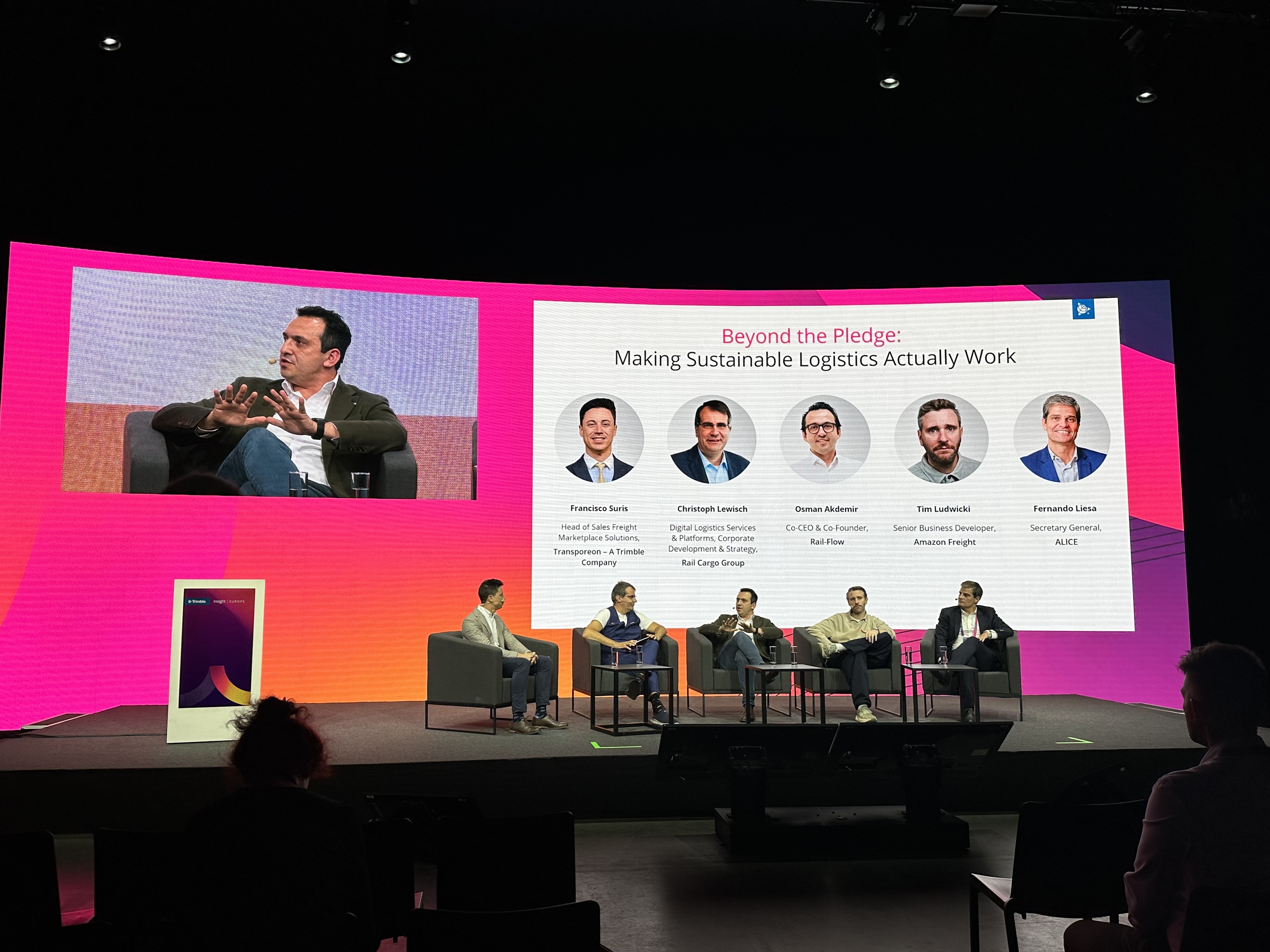
Osman Akdemir’s keyword was ‘progress’. Many of the old barriers have been cleared and a growing number of companies are already shifting volumes to rail. What is missing is the step from words to action on the shipper side. The obstacle is complexity: a transport to Italy quickly involves around ten companies, from the shipper and two trucking firms to two terminals, a railway undertaking and a wagon inspector. In road transport it is often one company from start to finish. Sustainability only works if all of them speak the same language.
For twenty years the industry has tried to solve this with standards, and in his view it has mostly failed. Getting ten companies onto one standard is unrealistic when each has different processes and reads interface standards differently. AI removes the need for that agreement: it takes in any data format, translates it and keeps learning. On that basis, Rail-Flow has connected around 60 terminals and around 30 operators without prescribing a single standard.
"Sustainability will only win if we stop spending so much energy waiting for agreements and standards, and start using what is already there."
Making rail as easy as road
AI was a big topic in Brussels, but at the end of the day people move goods for other people. Technology can make capacity visible and speed up decisions. It cannot replace the trust and expertise that make logistics work, which is exactly why events like this one matter. Networking continued on Tuesday evening at Autoworld, where classic cars, good food and a few rounds of table football set the scene for many good conversations.
If we take one message home, it is this: making rail logistics as simple as road, meaning digital, connected and scalable, is a priority across industries. It is what shippers expect, what operators need and what a credible modal shift requires.
Our thanks go to the Trimble team, to everyone who stopped by our booth, and to our colleagues Dominik Fürste, Osman Akdemir, Michael Bott, Rémi Peschet, Frank Erftemeijer and Xenia Cleuvers. We are already looking forward to next year. Want to see how Rail-Flow makes rail as easy to book as road? Get in touch with us.
Want to see how Rail-Flow makes rail as easy to book as road?
Get in touch with us.
.avif)