

AI won’t take your job, but someone using AI might.
At railXchange 2026, Instaffo CEO Christoph Zöller argues that AI won't destroy jobs on net but will hand a decisive competitive edge to companies and workers who adopt it fastest, using history's technology waves and the Jevons Paradox to explain why speed, not size, will determine rail freight's winners over the next decade.
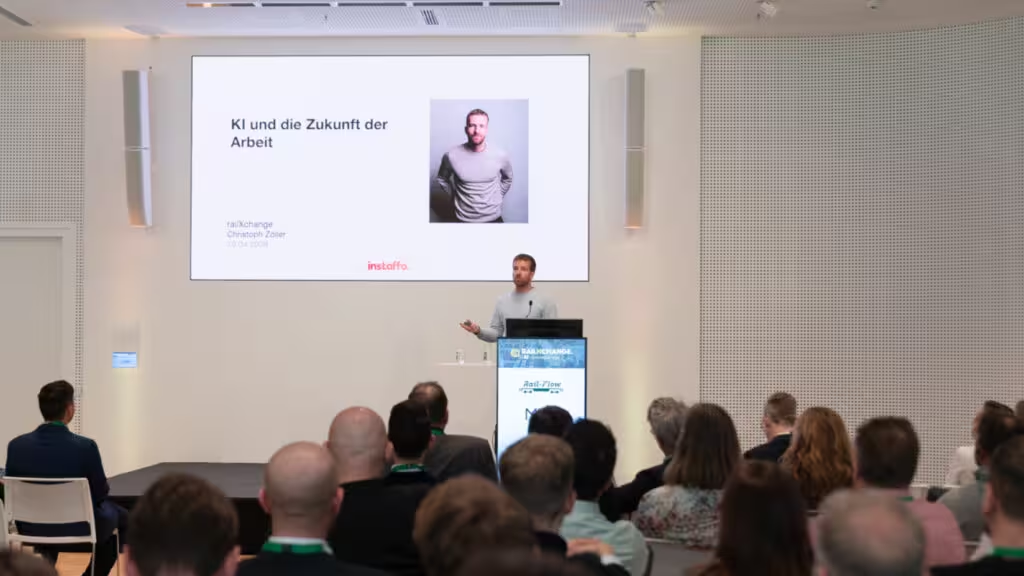
November 2022. ChatGPT goes online. Two months later, it has 100 million users. No product in the history of technology has grown faster. And since that moment, people around the world have been asking themselves the same three questions: Will my job still exist? Will my industry survive? Will my company still be standing?
Christoph Zöller, who built Instaffo, one of the largest recruiting platforms in the German-speaking market, into an eight-figure business, lives these questions every day. His company watches how AI reshapes the job market in real time. At railXchange, he shared his honest, unvarnished take on what’s actually happening.
Key Takeaways
- Efficiency gains historically create more jobs, not fewer. Instaffo CEO Christoph Zöller invokes the Jevons Paradox: when AI makes a team 50% more productive, the smart move is to pursue new markets, not cut headcount — citing the WEF's Future of Jobs Report projection of 92 million jobs lost but 170 million created by 2030.
- This tech wave is different because of speed, not scale. Generative AI hit a €60 billion revenue run rate in under two years, versus nine years for the PC and thirteen for the internet, leaving companies far less time to adapt than in past technological transitions.
- New jobs won't extend today's companies—they'll come from new players moving faster. Zöller argues the real competitive threat isn't AI itself but rivals who rebuild processes around it from scratch, making critical thinking, ethical judgment, and leadership, paired with the courage to engage AI directly, the traits companies most need to develop now.
Three narratives. One reality.
When you ask people about AI and jobs, three opinions tend to emerge. First: AI is massively displacing workers and many jobs will disappear. Second: not much will really change, AI is overhyped and will fade. Third: more jobs will be created than ever before.
Zöller’s view? The first narrative is largely a media story. Bad news sells, and fear drives clicks. The second underestimates a technology that is clearly here to stay. The third is closest to the truth, but with important nuance attached.
We’ve been here before
Every major technological wave in history triggered the same fear of mass unemployment, and every time, that fear turned out to be wrong in the long run.
During the industrial revolution, the Luddites destroyed machines because they genuinely feared losing their livelihoods. In the short term, some traditional trades did disappear. But entirely new industries emerged that no one could have imagined beforehand. The same pattern repeated with electricity, with the assembly line, with industrial robotics.
Each time, the transition created better working conditions and more jobs overall, just different ones.
The difference this time is speed. Earlier technological waves unfolded over decades. Companies had time to adapt. That luxury no longer exists.
Generative AI reached a €60 billion annual revenue run rate in under two years. The PC took nine years to reach the same milestone. The internet took thirteen years. ChatGPT reached 100 million users in two months, the fastest consumer service adoption in the history of technology. And development has only accelerated since.
The Jevons Paradox: Why efficiency doesn’t mean fewer jobs
A common assumption goes like this: if AI makes my team 50% more productive, I’ll lay off half of them. Zöller pushed back hard on this.
There’s an economic principle called the Jevons Paradox: when efficiency increases, overall demand tends to rise, not fall. If a law firm can draft contracts 60% faster, a smart leader doesn’t fire 60% of the team. They ask how to use that competitive advantage to open new markets and take on more clients.
Historically, efficiency gains have consistently led to higher productivity and growth, not to job losses. The World Economic Forum’s Future of Jobs Report 2025 puts it in numbers: 92 million jobs will be lost by 2030, but 170 million new ones will be created.
The net is positive. But the distribution is not even.
The jobs won’t appear where you expect
Here is where Zöller sharpened the message beyond what most reports say: the new jobs won’t be created as extensions of what existing companies are doing today. They will be built by new players, on new structures, at new speed.
Companies that use AI to rethink their processes entirely, not just to speed up the old ones, are building a competitive lead right now that will be very difficult for others to close. The question has shifted from “how can I do this faster?” to “does this even need to look like this anymore?”
Those who are building now are making the rules. Those who wait will play by them.
What humans bring that machines can’t
None of this means humans become irrelevant. Zöller was clear about what remains distinctly human, and what companies should be actively developing in their people:
Critical thinking – the ability to question, evaluate, and classify AI output rather than accept it blindly. This, he argued, is one of the greatest risks of the current moment, especially for younger generations growing up with AI.
Ethical judgment – deciding when a machine is allowed to make a decision and when a human must be in the loop.
Creative problem-solving – moving fast and taking real action, not just generating options.
Leadership and accountability – owning outcomes in a world where processes are increasingly automated.
And one quality that rarely appears on such lists: courage. The courage to engage with AI directly, not to delegate it to the IT department and hope for the best. Leaders don’t need to be able to code. But they do need to understand what AI can and cannot do – otherwise others will make those decisions for them.
The window is open now
We are, Zöller argued, in a gold-rush moment. Market shares that have been stable for years are up for redistribution. The winners of the next decade will not be determined by size, history, or resources. They will be determined by timing and determination.
For an industry like rail, with its complex systems, fragmented data, and historically slow pace of digital adoption, this is both a challenge and a genuine opportunity. The technology exists. The tools are accessible to non-programmers. The only remaining question is whether the people and organizations in this industry are willing to act.
AI will not take your job. But it will transform what that job looks like. And the companies that start that transformation now, rather than waiting for certainty, are the ones that will define what rail looks like in a decade.
The moment is now, not in two years’ time.
Christoph Zöller is Co-Founder & CEO of Instaffo, one of the largest recruiting platforms in the German-speaking market. He spoke at railXchange 2026 in Frankfurt.

.avif)