REAL-TIME TRACK & TRACE
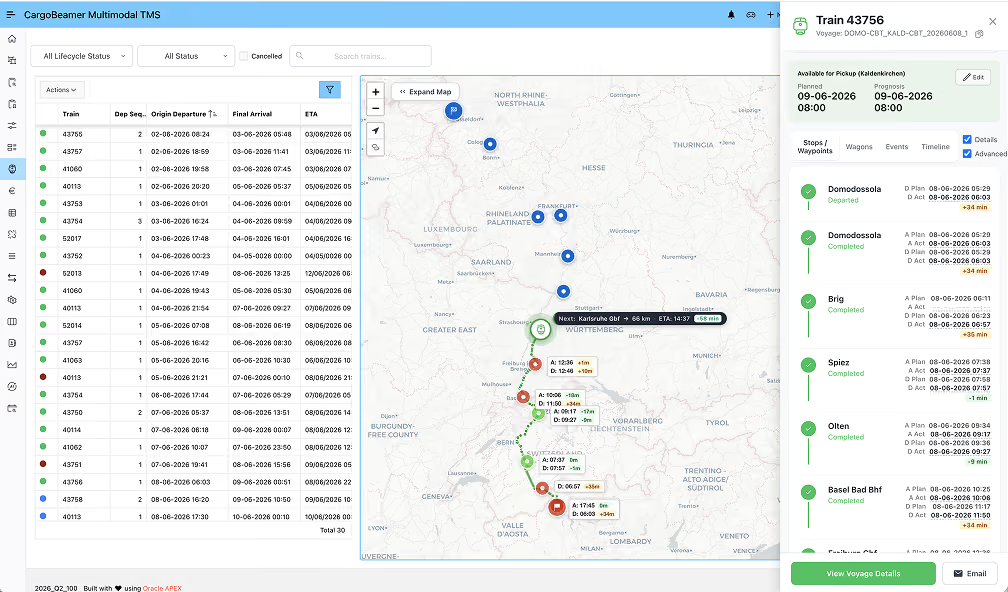
Get live ETAs, exception alerts, and full transport visibility across your entire rail and intermodal network - from departure to final delivery.
CAPABILITIES
From departure to delivery, track every train, wagon, and intermodal unit in your network with real-time updates and intelligent alerts.
Exception handling
Stop reacting to delays after the fact. Rail-Flow detects exceptions in real time and pushes ETA updates to your team and your customers automatically. Proactive notifications for delays, non-conformities, and route deviations. Decision support helps dispatchers resolve issues before customers notice.
Automatic alerts for delays, missed handovers, and route deviations.
Continuous ETA updates based on live position data and downstream constraints.
Suggested next actions ranked by impact so your team resolves issues fast.

REAL-TIME TRACK & TRACE
Get a personalised walkthrough of how Track & Trace works for your network.
Everything you need to know about Real-Time Track & Trace. Anything missing? Just ask during your demo.
Have a question that's not covered here? Reach out and we'll get back to you within one business day.
Rail-first, intermodal-fully-supported. The TMS handles block trains, wagon groups, single wagon, load units (trailers, containers, swap bodies), and the surrounding legs by road, barge, and ferry — all managed end-to-end through Intermodal Offer Management and Intermodal Capacity Booking.
Yes. Rail-Flow plugs into SAP, existing TMS, and legacy ERP systems via standard EDI and open APIs. For industrial shippers, Rail-Flow typically acts as the rail-and-intermodal extension on top of SAP.
The TMS runs your operations - contracts, planning, execution, invoicing. The Marketplace connects you to Europe's rail freight network for tendering and booking. They work standalone, and even better together.
Typical go-live is 8–12 weeks for the TMS, depending on scope and integrations. Marketplace sign-up is instant - most teams are running their first tender the same week.
Yes. Most customers start with one - typically Transport Management or the Marketplace - and add others as needed.
Most customers go live in 6–12 weeks, depending on scope, integrations, and data migration. We provide a dedicated onboarding manager throughout the process.
Yes. Transport Management works standalone and connects seamlessly to ROM, Fleet Management, and the Marketplace when you are ready to expand.
Rail-Flow connects to your ERP, telematics, and partner systems via 180+ productive EDI / API integrations. SAP, Microsoft Dynamics, and custom systems are all in scope. New integrations are typically built in weeks, not quarters — and the cost stays predictable because the connectors run on the same platform.
Yes. Most customers run a phased rollout — by country, business unit, or transport type — and operate Rail-Flow in parallel with their legacy system during cutover. We help define the migration sequence so contracts, orders, and master data move over cleanly, without disrupting daily operations.
Rail-Flow is ISO 27001 certified, GDPR compliant, and hosted entirely in the EU — full documentation of our security controls is available on request. For customers with stricter requirements, we also offer a dedicated private-cloud deployment at additional cost, hosted under your own data-sovereignty terms.
Yes, direct RSRD integration is built in. UIC codes, technical parameters, capacity, and certifications sync automatically. Onboarding a new fleet typically takes minutes, not weeks. Manual import is supported for non-UIC wagons (e.g. international or specialised stock).
Yes. Every wagon carries its ownership designation (own, lessor name, customer-related), and the platform differentiates availability, maintenance responsibility, and cost allocation accordingly. Contribution margin per wagon accounts for ownership mix automatically.
Yes. Maintenance documentation is ECM-ready, with full audit trail and traceability of serialised components. AVV-standard damage codes are built in — you can also create your own. GCU compliance is supported for European wagon keepers. Workshop dispatch handles regulatory inspections and modification campaigns.
Open API connects with the major fleet ecosystems: SAP, IBM Maximo, Oracle ERP, zedas®asset, Carl, sternico, and others. Telematics providers integrate via standard interfaces — Kasasi, Nexxiot, Savvy CarGo, and equivalent. Custom integrations developed within weeks.
Orders in the TMS pull from Fleet master data. Damages from operations route to Fleet. Repair and maintenance costs allocated per wagon and forwarded to your ERP. Standalone or platform — your choice.
Rail-Flow TOS is a full terminal operating system scoped for inland and KV terminals, not a yard add-on bolted onto something else. Gate, yard, train, M&R, reefer, customs, and invoicing run on one cloud-native platform, with the rail side handled natively: CIM e-waybill, LSEOP and Binias, RID separation, and wagon checkout all built into the core. It is a great fit for a 20,000 – 100,000 container per year inland terminal at a fraction of the cost of deep-sea systems.
A Phase 1 MVP covering gate, yard, train, and M&R is typically live in 2 to 8 weeks on a single terminal. A full multi-terminal rollout with EDI configuration, custom OPA / SOPA invoicing, and CEDEX M&R integration takes months rather than years, with the EDI scope being the main variable. Most customers start with gate and M&R, then add the rest.
Rail-Flow TOS fits inland intermodal terminals, KV terminals, container depots, multi-cargo terminals with rail handling, and chemical-park rail terminals — all sized between 20,000 and 300,000 containers per year. Below that volume the TOS will likely be over-spec, and above it deep-sea systems like Navis or Tideworks are the right tool, not Rail-Flow.
Rail-Flow TOS is purpose-built for a different segment than any of these. Navis N4 and Octopi serve deep-sea container terminals at the 1M+ TEU scale, and Berghof BLU 2.0 is the legacy on-prem KV standard in Germany. Rail-Flow TOS is cloud-native and modular, built for small-to-mid inland intermodal, with rail and EDI native to the platform rather than bolted on.
Yes — CEDEX EDI runs live with Maersk, MSC, CMA CGM, and Hapag-Lloyd, and LSEOP to Infrabel and Binias to DB Netz are built in. CIM e-waybills generate with carrier confirmation tracked back into the platform. EDIFACT messages flow both ways for IFTMIN, CODECO, COREOR, COPARN, and IFTMCS, with port integrations live at Antwerp via APICS and at Rotterdam via Port Base.
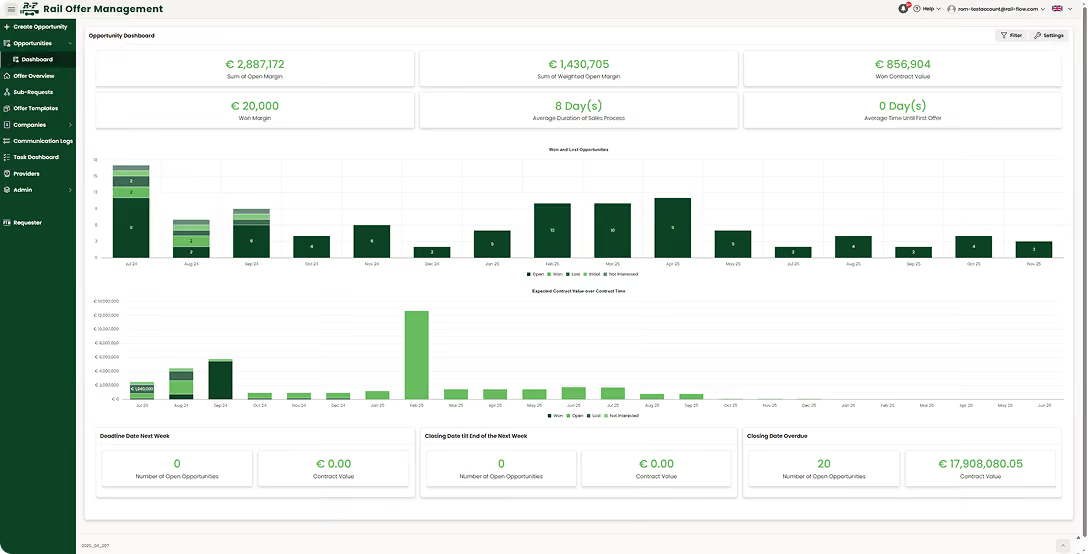
ROM is the rail-specific CRM and offer-management system in the Rail-Flow platform. It covers the full sell-side sales motion: opportunities, customer records, multi-leg pricing with a calculator, offer documents, pipeline visibility, and award handover to the TMS for execution. Built for the realities of rail freight sales — every tender type, every cost component, every multi-entity setup.
Block trains, single wagon loads, intermodal load units, services (e.g. shunting w and w/o traction), and asset rentals (wagons and locomotives) — each with its own data model and pricing logic. Custom tender types can be added on request.
Yes. Some ROM customers run alongside an existing corporate CRM for general account management. ROM handles the rail-specific sales motion (tenders, pricing, multi-leg offers); the corporate CRM handles account-level relationships. API and data sync available for relevant fields.
Stretch-by-stretch pricing with rail-specific cost components (locomotives, wagons, energy, personnel, traction, tracks, services, foreign currency). Re-usable calculation templates and price list management.
Tenders or single requests from PTM flow straight into the ROM pipeline – you won’t lose any sales opportunities. Won contracts in ROM flow into the TMS for execution. The same customer record runs across modules. ROM standalone or as part of the platform — your choice.
Role-based permissions across holding hierarchies. The sales team sees only the opportunities, customers, and pricing relevant to their entity. Management sees the rolled-up pipeline across all entities. Per-entity templates apply automatically — right brand, right contract terms, every time.
You'll receive a calendar invite within a few minutes. A Rail-Flow specialist will email you before the call to confirm your focus area - e.g. sales, ops, invoicing, fleet - so the demo is tailored, not generic.
No problem at all. Your calendar invite includes a reschedule link, so you can pick a new time in a couple of clicks. There is no need to email back and forth, and no penalty for moving the call. Life happens, and we would rather meet when it genuinely suits you.
Yes, a live look at the platform rather than a slide deck. How it works depends on the product. For our SaaS products, we start in a test environment, and if you would like to see how your own data would be processed in a specific use case, we arrange a more tailored demonstration as a second step. For our Marketplace products, you get a live walk-through directly on the platform. Either way, we focus on the features that matter for your area. You are welcome to ask questions and go off-script at any point.
Absolutely, and we encourage it. Bringing along colleagues from operations, procurement or IT often makes the conversation more valuable, since everyone can raise their own questions. Just forward them the calendar invite, or let us know in advance so we can tailor the session to everyone in the room.
The demo is completely free, with no strings attached. You will not be invoiced for anything, and there is no obligation to buy afterwards. It is simply a chance to see whether Rail-Flow is the right fit for your business, at no cost and no risk.
Most intermodal forwarders go live in 6–10 weeks. LTG Cargo went live in 6 weeks thanks to standard operator integrations. Additional modules (Intermodal Offer Management, Driver App & POD) roll out in parallel based on your priorities.
40+ intermodal operators across rail, short-sea, and barge, plus truckers on the road legs. The list grows continuously; we can confirm your specific partners on a quick call.
Through a customer portal in your brand, not oursor via standard APIs, if. they'd rather connect their own system. Customerente bookings, see real-time status, and rceieautomatic notifications without you sending a single email.
Yes. Standard APIs and EDI integrations move data both ways with most forwarder TMS and ERP platforms. Rail-Flow runs standalone or as a connected module, use one or several alongside your existing stack.
Absolutely. Most forwarders start with Intermodal TMS where the operational pain is sharpest, then add Intermodal Offer Management and Driver App & POD once value is proven. PTM has a freemium tier you can try today, no commitment.
The standard solution with our existing interfaces typically goes live in 6–10 weeks. Additional modules (TOS, IOM, Marketplace), enhancements, custom integrations, or broader rollout are then delivered in parallel, sequenced around your priorities.
Yes. Rail-Flow integrates with your existing TOS via API, EDI, or file exchange, so you can run our TMS alongside the terminal system you already have.
Your partners connect toRail-Flow, not to each other. We already have live integrations with around 100+RUs, terminals, and wagon keepers, so a new partner is usually already connected. If not, onboarding is quick via standard EDI, our module that reads and writes virtually any data format, or a supplier portal the partner uses directly. You send wagon lists and booking instructions from one system andhold a single picture. New connections take days, not months.
Yes — full CIM/CUV support is built in, including dangerous-goods handling, RID separation on the wagon plan, audit-ready compliance trails, and automated way bill generation.
Absolutely. Most operators start with the operational handling of the process in the Intermodal TMS, where the pain is sharpest, then expand to the customer portal and commercial module. From there, many continue with the TOS, IOM, and further integrations once value is proven.
Intermodal doesn't stop, and neither do we. You get a dedicated support line and 99.8% platform uptime, so the system is there when your trains, wagons, and terminals are moving, day or night.
Default First-Time Checklist
Most rail operators go live on the core RTMS in 8–14 weeks for a single business line. Multi-country / multi-subsidiary rollouts are phased — no "big bang" required. ROM and Fleet modules roll out in parallel based on your priorities.
ICB is Rail-Flow's marketplace for short-term intermodal slot booking. It connects three roles: forwarders booking intermodal capacity, carriers selling first and last mile trucking, and operators selling spare train capacity as a digital sales channel. Live since 2021, free to use today.
Yes. The Free plan lets you self-register, send unlimited spot requests, receive comparable offers from 300+ providers, and access standard tender templates with rail-freight specifics. No contract, no credit card. Upgrade to Premium when you need additional features, custom workflows, or integrations.
Yes. Rail-Flow extends SAP rather than replacing it. Standard APIs and EDI move data both ways, and your ERP stays the system of record. The logistics order flows to Rail-Flow's TMS, which sends the rail order to the railway undertakings.
Rail-Flow integrates data from railway undertakings, terminals, and trucking partners into a unified view, providing consistent status updates regardless of the carrier involved. And where a carrier isn't connected via data feed, we can involve them directly through our carrier portal.
Rail-Flow extends your existing stack rather than replacing it. Standard APIs and EDI move data both ways — SAP, MS Dynamics, Bravo, and other legacy systems stay in place. Rail-Flow handles what they were never designed to do.
Free to use for both sides today. Forwarders see prices set by carriers — flat rates per loading unit or progressive (per-km / per-kg). Carriers set their own pricing per route, date, unit type, and conditions. Rail-Flow is currently growing the network; future pricing may include premium features, but signup today is free of commitment.
Click "Try for free" and complete the self-registration form. We review new accounts to keep the marketplace high-quality — approval typically within one business day. Once approved, you can send your first request immediately to every relevant provider on the platform.
No. Rail-Flow is designed for procurement and operations teams without rail-specific expertise. Our customer success team supports onboarding, and the platform handles CIM/CUV, dangerous-goods rules, and cross-border specifics for you.
The system monitors for delays, missed handovers, route deviations, and customs holdups - automatically alerting your team when action is needed.
Yes. A Top-3 European rail freight operator runs Rail-Flow across 15 countries and multiple subsidiaries today on standardised order-to-cash workflows. Multi-entity support, multi-currency, multi-language all built in.
Each marketplace serves a different sourcing need. ICB is for short-term intermodal slot booking (rail + truck pre / on-carriage). PTM is for rail freight tenders (block trains, single wagon load, intermodal). RSB is for short-term locomotive leasing. RCB is for single wagon load capacity discovery. They share the Rail-Flow marketplace family but have distinct ICPs, workflows, and product maturity.
Yes. We offer an NDA function, so only providers who confirm it gain access to the detailed information (lanes).
Absolutely. Most customers start with PTM, where the procurement pain is sharpest, and add Transport Management and other modules once value is proven. PTM has a freemium tier you can use today, no commitment.
Yes. The customer portal gives your clients self-service access to shipment status, ETAs, and documents without exposing your internal operations.
Absolutely. Most rail operators start where the pain is sharpest: TMS for those with order-to-cash gaps, ROM for those with a sales-side CRM problem, Fleet for those with wagon visibility gaps and then expand once value is proven.
For carriers running Rail-Flow's Intermodal TMS (ITMS), the ICB ↔ ITMS integration handles timetables, prices, booking data, and status updates automatically — no double entry. For other TMS platforms, custom integrations are possible — talk to our team about your specific stack and we will explore options.
Yes. Every provider profile shows the certificates already set up, and you can request additional certificates within the tender if needed.
350+ vetted transport providers across 27+ countries. PTM customers have averaged a 40% efficiency gain on the tender process and have surfaced offers from providers they hadn't worked with before, including for short-haul and unusual routes.
Absolutely. The solution covers full rail transports, combined rail-road movements, and last-mile trucking within a single tracking interface.
Yes, 315+ rail freight providers across 27 countries trade capacity on the Rail-Flow Marketplace today. PTM for procurement, RSB for locomotive rental, RCB for wagon and traction sharing. Listing as a provider is free.
Self-registration takes a few minutes. Choose your role at signup: operator (provides train capacities), carrier (provides first / last mile trucking), or forwarder (books intermodal slots). Some organisations register multiple roles. Our customer success team reaches out shortly after signup to help with first capacities or first bookings.
You can tender single wagon loads and block trains, whether intermodal or conventional, from a single wagon up to hundreds of lanes.
Yes, full CIM/CUV support is built in, including dangerous-goods documents, audit-ready compliance trails, and automated waybill generation. Critical for chemical, steel, and automotive shippers.
It connects natively with Order Management, Planning, and Invoicing, so status updates flow automatically into your execution and billing workflows.
Every offer shows the CO₂ saving versus a comparable all-road move, calculated per transport. The comparison uses distance, loading unit, and mode-specific emission factors for each leg: rail plus pre- and on-carriage. Forwarders can use the figures for customer and sustainability reporting.
MORE FROM TRANSPORT MANAGEMENT
Discover other capabilities of the Transport Management solution that work alongside Track & Trace.

Streamline transport order intake, validation, and assignment across your operations. Smart order breakdown splits complex orders for multiple carriers.

Generate invoices automatically based on executed transport services. Auto-matched billing data with contracts and execution records.