Rail-Flow Isn’t Fighting Startups — It’s Fighting Excel.
Following a €12.5M funding round, Rail-Flow is doubling down on AI, with Co-CEO Dominik Fürste explaining in a DVZ interview why Excel and email: not other rail-techstart-ups are the company's real competition.
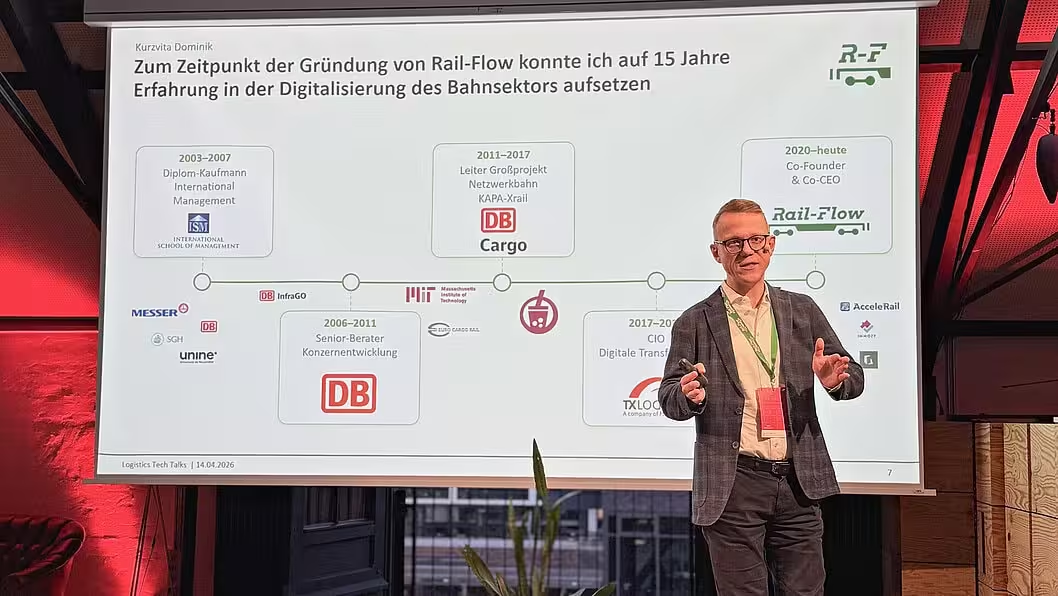
After closing a €12.5 million funding round in December 2025, Rail-Flow is doubling down on artificial intelligence. At the Logistics Tech Talks in Hamburg, Co-CEO and co-founder Dominik Fürste spoke with DVZ about where that investment is heading, and why the company's toughest rival isn't another rail-tech startup, but the humble combination of Excel and email. Closing the round at all was no small feat: with far less capital available than three or four years ago, the process took close to a year from preparation to signature and involved conversations with around 150 investors. For Fürste, the result is a milestone worth being proud of, and the starting point for a new growth phase built on AI and international expansion.
AI that actually fits logistics
There's no off-the-shelf AI for rail logistics, Fürste argues. The near-term potential lies in rethinking how information reaches people: instead of clicking through menus, staff will be able to prompt directly inside the system, pull up the relevant context instantly, and trigger actions from there, a particular advantage for newer colleagues still building their domain expertise.
Looking further ahead, Rail-Flow is working toward agentic dispatching, where virtual colleagues handle pre-planning and prepare decision proposals for a human to confirm. That's a target picture, not today's reality; the company has assessed around 15 possible use cases to map out which foundations still need to be built.
Crucially, much of Rail-Flow's AI spend points inward. The company invests a five-figure sum each month in internal tooling that streamlines the entire software development process, from requirements capture to automated quality assurance. An AI-First strategy, an AI Transformation Manager, and a Head of AI back this up, because, as Fürste puts it, a lean American startup with a handful of AI specialists could otherwise overtake them. That pressure is a motivator.
Digitalising a sector decades behind
Rail freight, Fürste estimates, trails other modes by 20 to 30 years in digitalisation. He recalls a project at Deutsche Bahn to mount fax machines on locomotives, abandoned because reception was too poor. The anecdote captures both how far the sector has to go and how enormous the opportunity is.
The challenge is process complexity. Building something quickly is easy; making it work reliably across the chain is not, which is why so many solutions and companies have failed to stick. Rail-Flow tackles this by digitalising the full order-to-cash process end to end, automating where possible and connecting every actor — customers, service providers, terminals and railways — through a now triple-digit number of integrations. With no standardised interface across the industry, bringing it all together is the core of what Rail-Flow does. Its marketplace lets buyers request transport services from all roughly 100 European railways at once.
The real competitor: Excel and email
The platform itself is well received. The honest alternative most prospects weigh isn't a rival product, it's carrying on with Microsoft Excel and email. Hence Fürste's line: in practice, the biggest competitor is Microsoft.
The bigger friction is around the word "AI" itself. Many prospects hesitate because their internal AI governance isn't yet defined or AI use hasn't been approved internally; in Europe, companies often regulate themselves more tightly than politics does. That may change within two years, but for now it's a fine line to walk. Security, meanwhile, is an increasingly urgent driver: with regulations like NIS-2 and real cyberattacks on mid-sized German freight railways, managing directors must act or face personal liability, and Rail-Flow is ready when they do.
Growing across continents
Rail-Flow's expansion is well underway. Australia's largest, publicly listed railway is now a customer, supported by local hires and a team in the Philippines for support and QA. In France, the company has built a German- and French-speaking sales team and landed its first major client. Next on the map: further growth in Poland, Europe's third-largest rail market, and a move into North America in 2026, a market roughly five times the size of Europe's. As for the US political climate, Fürste isn't worried: American firms are opportunity-driven, and a strong solution will sell regardless of the wider weather.
Read the full interview with Dominik Fürste on DVZ from June 8: "Rail-Flow-Co-CEO: „Unser größter Wettbewerber ist eigentlich Microsoft”